Bournemouth's Clay vs. Sandbanks' Sand: Groundworks on the Coast
Why do patios sink and walls collapse? Discover the massive difference between building on Bournemouth clay versus Sandbanks sand, and why standard groundwork quotes are a trap.
I get called out to a lot of collapsed retaining walls and sunken patios across Dorset.
The homeowner always blames the paving slabs, the bricks, or the mortar. I take one look at the site, dig a test hole, and know exactly what went wrong. The cowboy who built it didn't pay attention to the dirt.
You cannot use the same groundwork specs across this county. A mile down the road changes everything. If a builder gives you a "standard" quote for a sub-base without looking at what he’s digging into, you are going to lose your money.
Here is the reality of groundworks on the coast.
The Heavy Clay: North Bournemouth & Broadstone
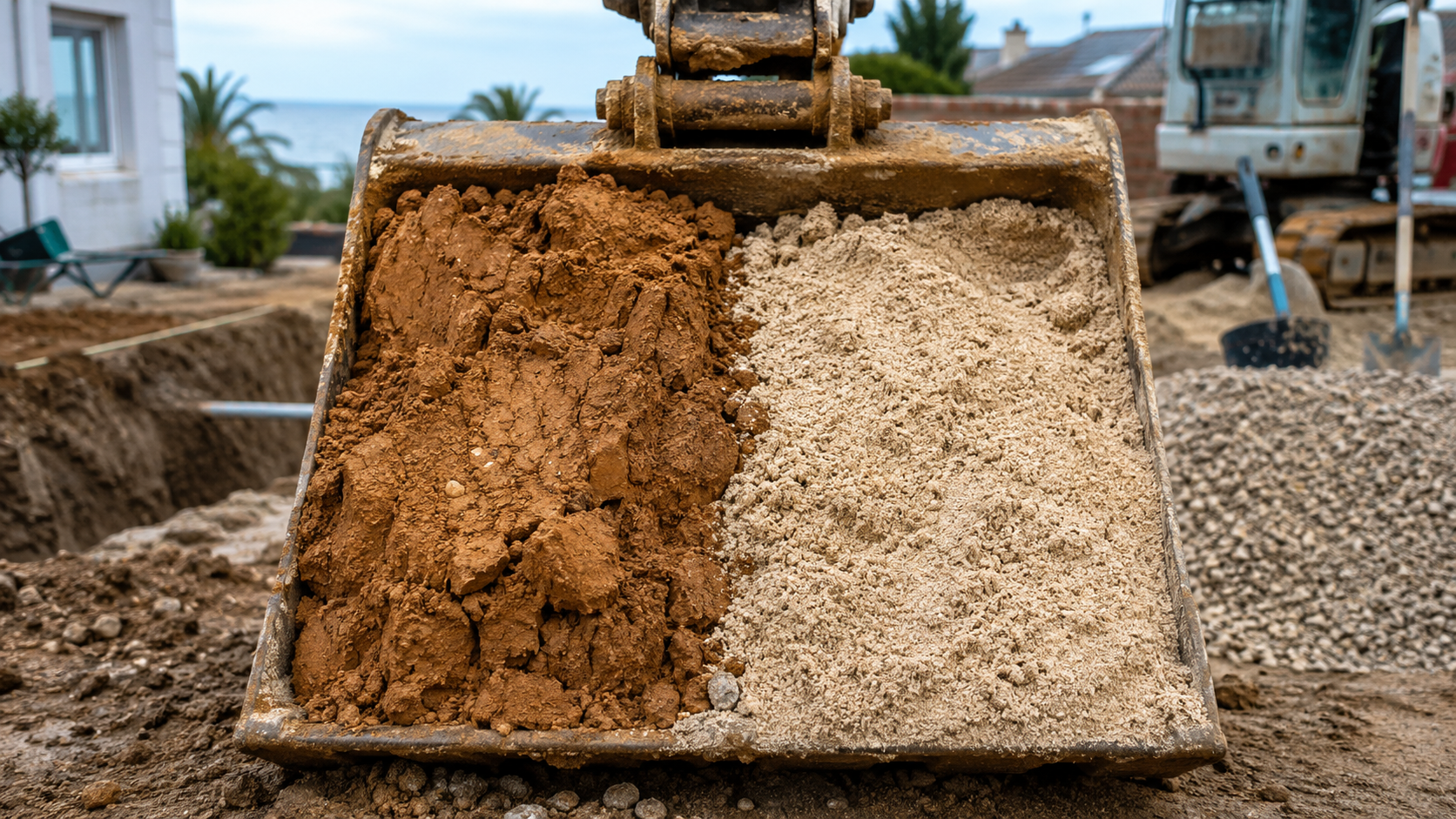
Up around North Bournemouth, Talbot Woods, or Broadstone, you hit solid, heavy clay within a spade’s depth.
Clay is an absolute nightmare. It holds water. When the autumn rain hits, the ground swells up. When January hits, that trapped water freezes and expands. We call it "ground heave." If you just scrape off the grass, chuck down a standard 100mm layer of hardcore, and lay a stone patio on top? The winter freeze will literally heave the ground up and snap your expensive porcelain slabs in half.
For clay, we have to dig deep. Really deep. We excavate way past the standard depths, lay heavy-duty woven membranes to stop the muck mixing, and pack in massive amounts of MOT Type 3 sub-base. It’s the only way to create a solid, draining buffer so the clay can move underneath without destroying the surface above.
The Shifting Sand: Sandbanks & Canford Cliffs
Drive ten minutes down to Sandbanks, Lilliput, or Canford Cliffs. Completely different world.
You’re basically building on the beach. Sand drains brilliantly, so water logging isn't the issue. The problem is it shifts. It’s totally unstable under heavy loads.
Try building a heavy masonry retaining wall on a standard trench footing in Canford Cliffs. Within two years, the sand shifts and the wall leans right over. Or try laying a heavy block paving driveway. If you don't line the entire excavated hole with heavy-grade geotextile fabric, the expensive hardcore sub-base will just slowly sink into the sand under the weight of your cars.
We engineer massive, oversized reinforced concrete footings for walls on sand. We over-engineer the driveway grids. You have to lock the ground in place before you build up.
The "One Size Fits All" Trap
This is exactly why quotes vary so much.
You get three quotes for a new driveway. The cheap bloke is using a standard "150mm sub-base" template for every single job he prices. He doesn't care if your postcode sits on shifting sand or waterlogged clay. He's just going to dig a shallow hole, tip a lorry load of stone in, whack it down, and take your money.
A year later, the drive drops and he stops answering his phone.
Engineered to the Postcode
At GW Landscaping+, we don't guess. We engineer the groundworks to the exact geology of your postcode. If we hit clay, the spec changes. If we hit sand, the spec changes.
The paving on top is just the finish. The real money, and the actual engineering, goes into the hole underneath.
If you want a build that actually stays level, pop down and see us at 78 Alma Rd, Bournemouth BH9 1AN, UK, or ring the site phone on 07835 390845. We’ll look at your dirt and tell you exactly what it needs.